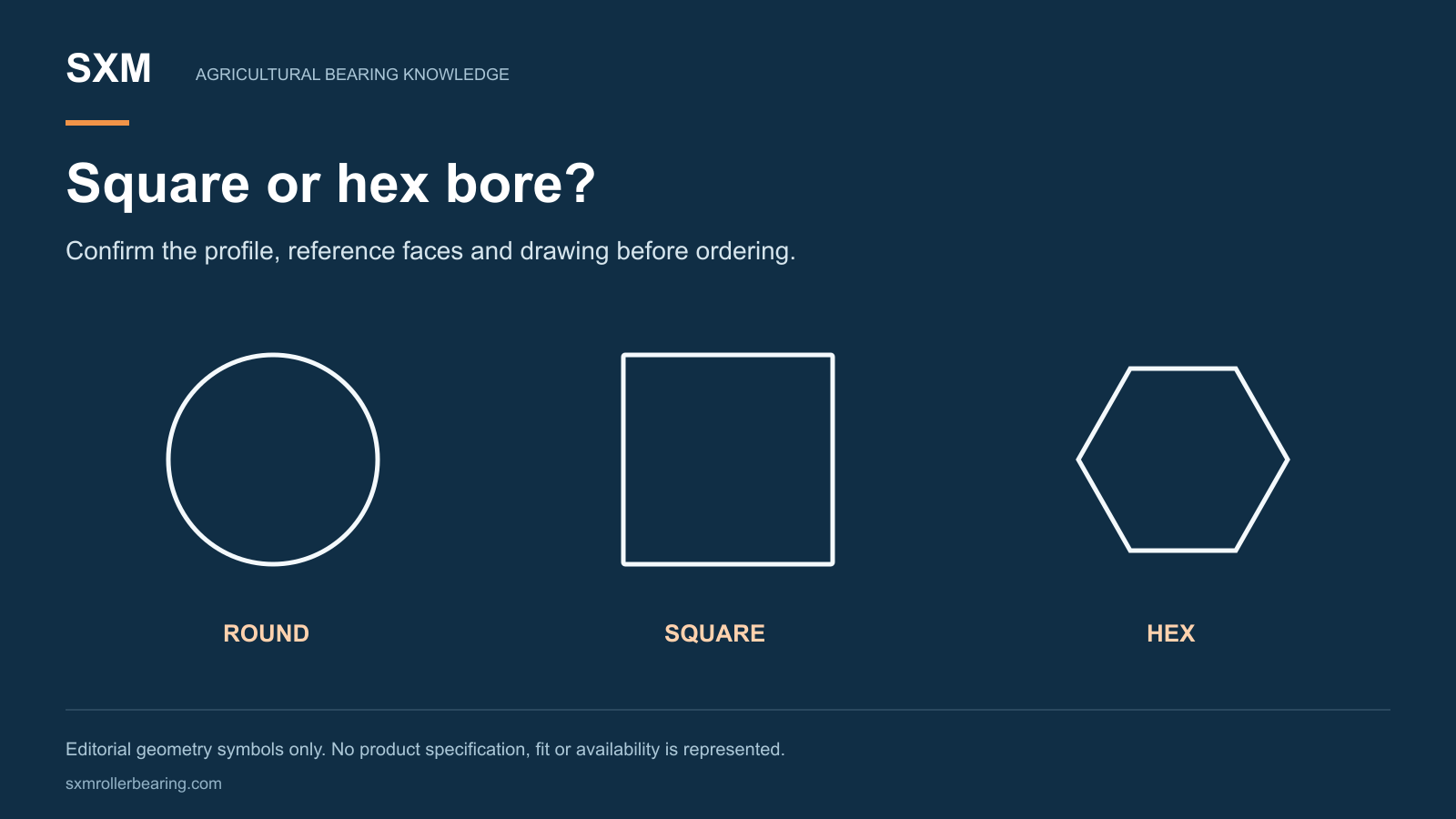
Square and hex bore agricultural bearing identification starts with the complete marking, the bore profile and a dimension tied to the correct reference faces. Record units, photograph both sides and compare the outer-ring profile, ring widths and supplied assembly scope with a drawing. A square opening or a familiar outside diameter is a useful clue; it is not a complete replacement specification. Keep uncertain observations separate from confirmed requirements before requesting a quotation.
For a distributor, machinery-parts buyer or maintenance team, the goal is a reference that another person can check. A useful enquiry explains which part was observed, how its dimensions were recorded and which documents still need confirmation. This guide focuses on that identification task within the agricultural bearing range.
Why bore shape needs its own identification record
Agricultural bearing catalogues include more than conventional round-bore products. PEER’s product guide describes round, square and hex bore agricultural bearings in inch and metric sizes. That establishes the range of possible identification questions; it does not establish an SXM part number, supplied execution or machine fit. PEER Product Guide, agricultural bearings.
An enquiry that says “farm bearing” can hide several unresolved details. A photograph may show the opening clearly while concealing an extended inner ring, a different outer surface or a separate housing. A copied number may identify a family without preserving the suffixes needed to review the particular item.
Give each candidate part its own identity record. Keep the marking, bore description, measurements, photos and drawing together. That makes it possible to compare a supplier’s offered reference with the requested part without relying on visual memory or a shortened stock description.
Start with the marking, then describe the opening
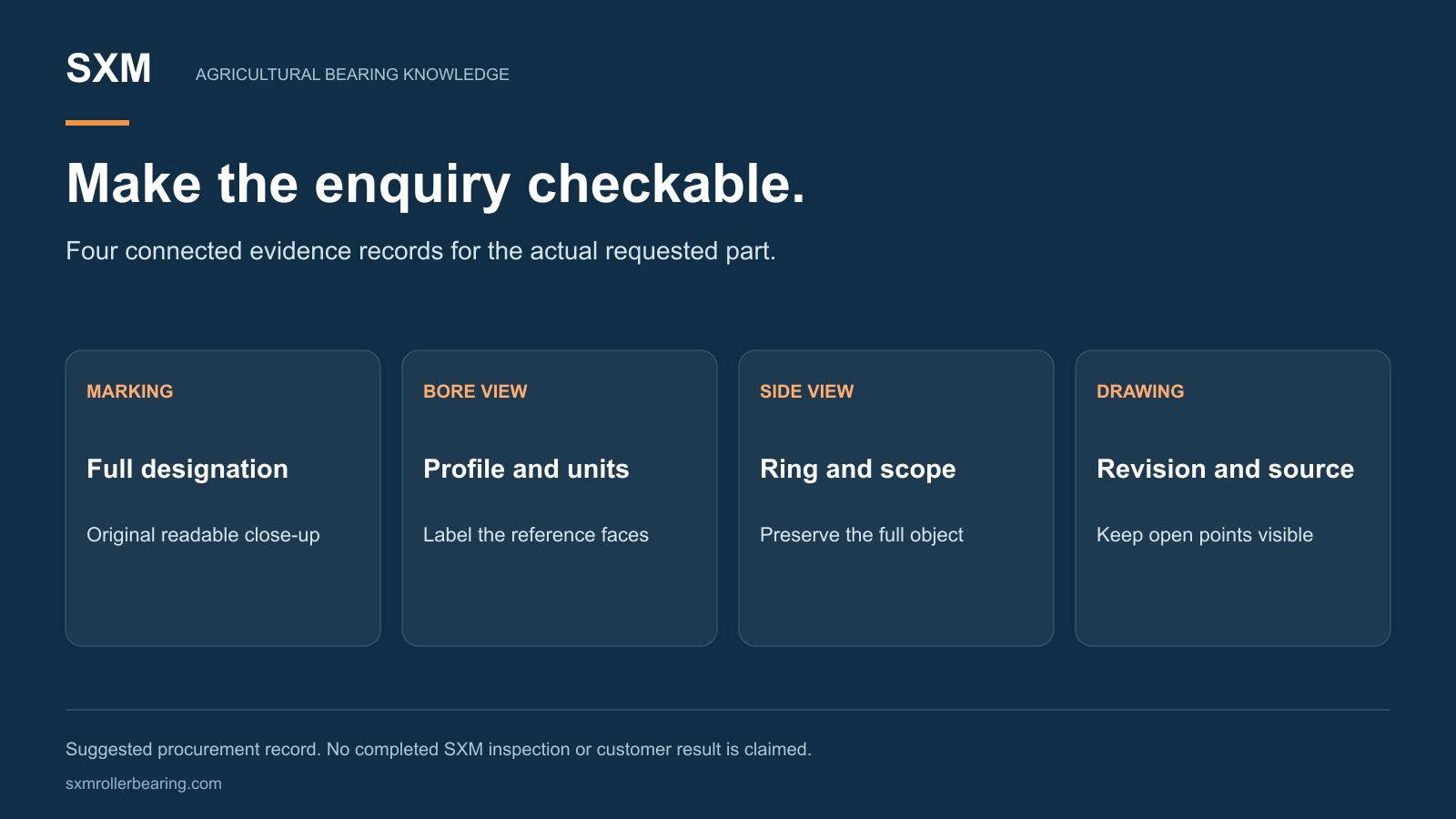
Preserve the full designation
Photograph the readable marking before rewriting it in a spreadsheet. Retain letters, separators and suffixes as shown. Where a character is obscured, label it uncertain and attach the original photo. Do not reconstruct a plausible code from a catalogue image.
Keep the manufacturer and complete designation in separate fields from the proposed replacement. If an old carton or invoice is available, label its source and date. A packaging reference is supporting evidence; confirm that it actually belongs to the removed component rather than a nearby spare.
Use a straight-on view to record the bore profile
A face-on photograph should make it possible to distinguish a round, square or hexagonal opening. Add a second angle when reflections or the seal obscure the edge. Keep the full component in at least one view so the close-up remains connected to the right part.
Record the profile in words as well as photographs. “Square bore, size awaiting confirmation” is clearer than an unlabelled image. If the opening is damaged or difficult to see, keep that uncertainty visible instead of assigning the profile from the machine model.
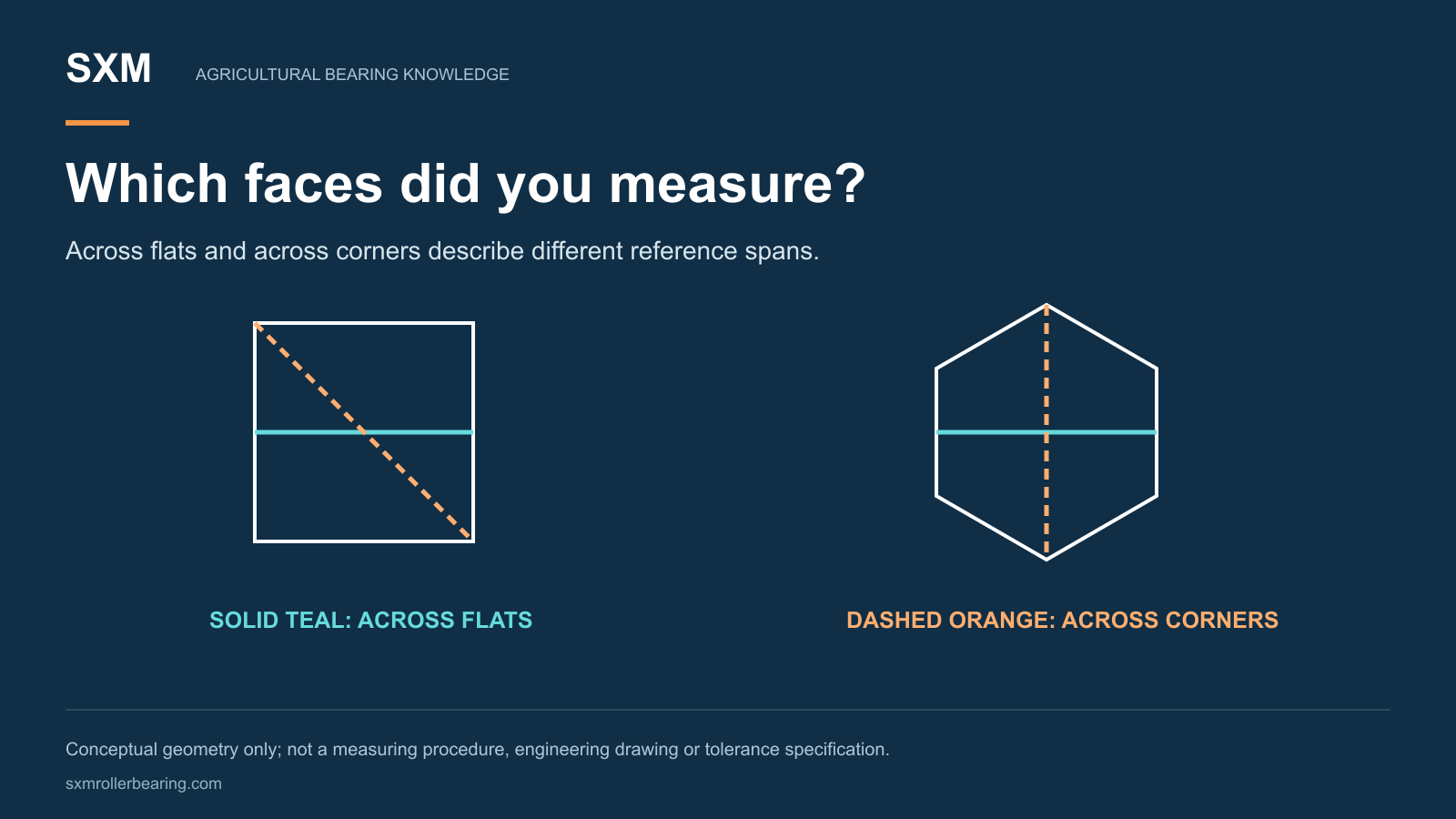
Distinguish across-flats and across-corners observations
State exactly which surfaces the measurement spans
Across flats refers to the separation between opposite flat faces. Across corners refers to the span between opposite corners. They describe different geometric references. A purchasing field labelled only “hole size” cannot show which was recorded.
For a square or hexagonal opening, identify the relevant faces on an annotated photo or drawing copy. Record whether the value came from the bearing, the shaft or a document. Preserve the unannotated original beside it. Do not convert one observation into a nominal bore specification until the applicable drawing convention has been checked.
A dimensioned drawing should settle which reference is required for the proposed item. Ask the supplier to point to that dimension on the offered drawing rather than answering only “same size.” Avoid rounding a workshop observation into a catalogue size to make the description look complete.
Treat a ruler photograph as context
A ruler beside a component can help establish approximate scale. Perspective, jaw position, glare and worn edges can still leave the relevant dimension unclear. Label such an image as approximate context; do not use it as evidence of a tolerance or precise fit.
Where a dimension matters to acceptance, have qualified personnel record it using a suitable method and the agreed drawing reference. This article does not prescribe a measuring instrument, acceptance tolerance or installation fit for a particular bearing.
Need to clarify a bore before ordering? Send SXM the complete marking, face-on photo and available drawing. Include the units and state whether the dimension is across flats, across corners or still unconfirmed.
Keep inch and metric records explicit
Retain the original unit shown on the document or measuring record. If a conversion is needed for comparison, show both the original and converted value, label the conversion and keep its precision appropriate to the source. A converted number is not a new measurement.
Do not assume that a value close to a familiar metric or fractional-inch size confirms the intended part. Ask for the actual nominal dimension and its source. Separate an approximate workshop reading from a manufacturer drawing value in the enquiry.
For mixed purchasing systems, add a unit field to every dimensional column. This helps prevent a distributor’s stock description, a maintenance note and a supplier drawing from being combined as though they used the same convention. If two records disagree, preserve both and request clarification before the order description is finalized.
Check the outer-ring profile and ring widths
The central opening is only one interface. Record whether the outer surface appears cylindrical or curved, then have that observation checked against the relevant drawing. Photograph the outer ring from the side; a front view alone can hide its profile.
SKF’s agricultural-bearing handbook distinguishes several agricultural bearing groups and configurations. Its disc-harrow and special-bearing sections illustrate why the complete configuration needs review. Use the document as reference context, not as an interchange table or a statement about SXM supply. SKF Bearings & CR Seals Specification Handbook, agricultural bearing sections.
Record inner-ring and outer-ring widths separately when the drawing distinguishes them. Note which side an extension appears on, and keep that orientation connected to the assembly record. If a flange, collar or other attached component is present, identify whether it is part of the quoted item or a separate piece.
Separate an insert from a complete housed assembly
A buyer may need the bearing alone, a housing alone, or an assembled unit. State the required scope rather than allowing a product photo to define it. For an assembly, retain the housing reference, mounting pattern and relevant drawing as separate evidence.
The pillow block bearing page is a commercial starting point for enquiries involving housed units. It does not establish that a particular insert and housing are interchangeable. Ask for the exact offered combination and the documents used to review it.
When several removed parts are laid out for a photograph, label which items belong together. Do not put an unidentified insert into a convenient spare housing for the image. That can accidentally create an apparent assembly which purchasing later treats as the installed arrangement.
Record seal and lubrication details without inventing a rating
Photograph both sides of the bearing and transcribe visible seal-related markings. Describe the observed environment using maintenance records: dust, crop residue, mud or wash exposure, where applicable. Keep those observations distinct from a conclusion about the required seal design.
A dark seal in a photograph does not establish material, lip construction, temperature capability or an ingress rating. Likewise, a visible grease connection on a housing does not settle the lubrication specification of every component inside it. Request the proposed configuration’s documentation where the requirement matters.
For a quotation, identify the existing execution and ask the supplier to list any difference. Do not turn a general catalogue statement about sealing into an SXM performance promise. Any application-specific acceptance decision needs the appropriate technical review and actual operating information.
Build a dimension record that another buyer can audit
Use a short evidence table rather than a single free-text “size” cell. The entries below describe information to collect, not dimensions or specifications for a supplied product.
| Record | What to capture | Source to retain |
|---|---|---|
| Bore profile | Round, square, hexagonal or unresolved | Face-on original photograph |
| Bore size | Value, unit and reference faces | Drawing or labelled measurement record |
| Shaft observation | Profile and relevant measured reference | Separate shaft record |
| Outside profile | Cylindrical, curved or awaiting review | Side photograph and drawing |
| Ring widths | Inner and outer widths where defined | Corresponding drawing callouts |
| Marking | Manufacturer and complete designation | Readable close-up |
| Assembly scope | Insert, housing or complete unit | Parts list or assembly reference |
| Open points | Conflicts, damage or unavailable evidence | Written clarification request |
Assign each row to the same part identifier. If the drawing and photo refer to different items, keep separate records until the relationship is confirmed. A clean-looking table should never conceal that the evidence came from more than one part.
Handle damaged bores and unreadable references carefully
Wear or damage can obscure the original profile and nominal size. Record what is visible, then ask the responsible maintenance contact which observations remain reliable. Do not treat a damaged edge or deformed corner as the intended production geometry.
If the marking cannot be read, collect the available equipment parts-list entry, drawing, retained packaging and earlier approved order record. Label each source. Ask which additional evidence is needed instead of requesting an unconditional replacement based on one damaged sample.
An illustrative enquiry might contain a clear square profile, an uncertain width and an invoice number that omits suffixes. The next step is to resolve those specific gaps, not to invent a full designation. This is a purchasing example, not a report of an SXM customer installation or inspection result.
Compare quotations against one documented requirement
Ask each supplier for the complete offered designation and the drawing or product record supporting it. Keep bore profile, dimensional references, seal execution and supply scope in the comparison. If a feature differs, ask for the difference in writing.
Do not let “equivalent” replace the evidence. A proposed alternative needs review against the actual requirement, including details outside this article. An approval for one bearing position should not be copied to another position because the two parts look similar.
Commercial comparison can then cover quantity, packaging, quoted lead time and the documents offered with the order. Obtain those details from the actual offer. No price, stock level, delivery promise or percentage saving is implied here.
For wider supplier assessment, use the existing agricultural bearing supplier checklist. Keep this page focused on the bore and drawing evidence that supports the enquiry.
Prepare samples and repeat orders with traceability
If a sample review is proposed, give the sample its own identifier and agree what question it is intended to resolve. State which documents accompany it and who will review the result. A sample on a desk is not automatically an approved production reference.
Keep the approved designation, drawing revision and scope of acceptance together. For repeat orders, confirm whether the requirement has changed before reusing an old description. Preserve the evidence behind the original decision so another buyer can distinguish an approved specification from a convenient stock nickname.
Ask what order-specific identity or inspection records can be supplied before shipment. Agree the scope rather than requesting an undefined certificate. These are suggested purchasing controls; they do not claim that SXM has performed a particular test or inspection for this enquiry.
Bring your bearing questions to Shanghai in December

SXM will exhibit at Booth 3HC002, Hall 3H, at the 2026 China International Bearing Industry Exhibition, 9–12 December 2026, at the National Exhibition and Convention Center (Shanghai). The official exhibition website confirms the event dates and venue. Our SXM exhibition invitation provides the booth information supplied by SXM.
Register as a visitor through the organizer
Open the official English visitor pre-registration form. Complete the required personal and company information, continue to the questionnaire, and follow the organizer’s submission and confirmation instructions. Returning visitors can use the login link provided there. Keep the registration confirmation and check current admission instructions before travelling.
Book a separate meeting with SXM
Exhibition registration and an SXM meeting request are separate steps. Contact SXM to request a meeting at Booth 3HC002 with your preferred date, company, contact details and bearing questions. Attach available markings or drawings in advance so the proposed discussion has a clear technical focus. Meeting time remains subject to confirmation.
Bring a labelled drawing or photo set rather than an unverified cross-reference. It helps frame a useful conversation about the actual requested item. Do not send sensitive or confidential drawings unless you are authorized to share them.
Frequently asked questions
Are square and hex bore agricultural bearings interchangeable?
Do not assume interchangeability. Confirm the shaft interface and the full bearing configuration against the actual assembly requirement. A similar outside diameter or catalogue family is not sufficient approval for a replacement.
What does across flats mean in a bearing enquiry?
It identifies the span between opposite flat faces. Label the relevant faces and units on a drawing or photo copy, then confirm which dimension the offered product drawing specifies. Keep across-corners observations separate.
Can a photo establish an exact bore size?
A photo can document shape and visible markings, but perspective and scale can leave dimensions uncertain. Use an appropriate measurement record or drawing for the required size and explicitly identify approximate observations.
Should I provide the shaft size or bearing bore size?
Record them separately, with units and sources. State which component was measured. Ask the technical reviewer to resolve the relationship against the assembly rather than combining both into one inside-diameter field.
What if my reference is an inch size?
Keep the original inch designation and value. If needed, add a labelled conversion for comparison. Do not infer a different nominal metric part from a rounded conversion or an approximate measurement.
Does contacting SXM register me for the exhibition?
No. Use the organizer’s official visitor-registration form for admission registration. Contact SXM separately to request a meeting at Booth 3HC002. Keep the organizer’s confirmation and SXM’s meeting confirmation as separate records.
Conclusion
An effective square or hex bore enquiry connects the full marking, reference-face dimensions, units, outer-ring details and assembly scope. Preserve uncertainty until the relevant drawing or evidence resolves it. That gives purchasing and the supplier a clearer basis for reviewing the proposed item.
Request an agricultural bearing quotation or a Shanghai meeting with SXM. Send the marking, drawing or photos, bore profile, available dimensions, quantity and the questions you need to resolve.