A spherical roller bearing W33 lubrication groove is an identification feature to check alongside the complete bearing designation and housing drawing. In the SKF designs described in its spherical roller bearing catalogue, W33 identifies an outer-ring annular groove with three lubrication holes; W20 identifies three outer-ring holes without that groove. These descriptions belong to the cited manufacturer’s system. They do not, by themselves, confirm another maker’s designation or a replacement’s suitability. SKF catalogue, printed page 6.
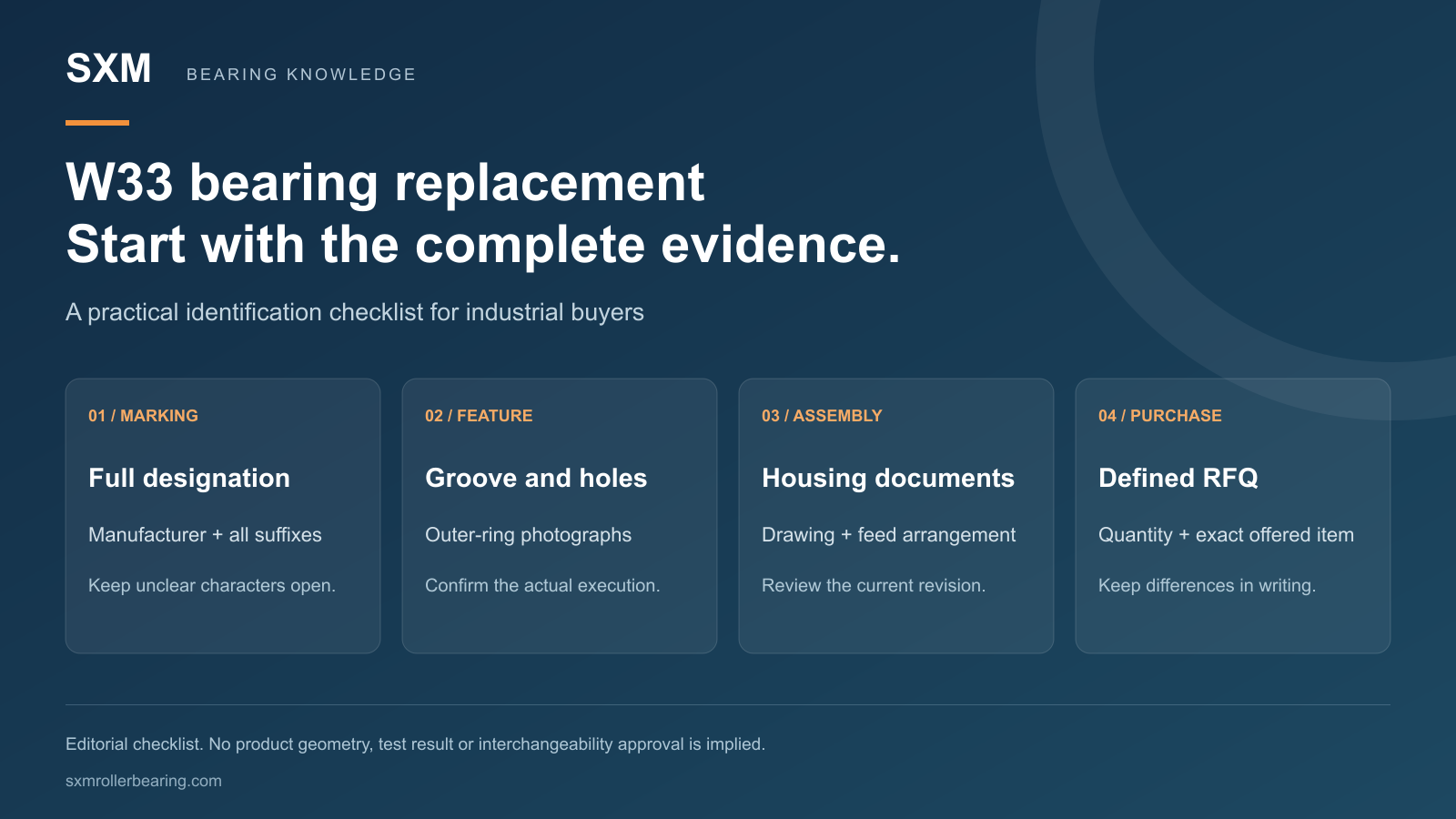
Before requesting a replacement, collect the full marking, clear outer-ring photographs, the installed housing reference and the lubrication-feed arrangement. Ask the supplier to identify the proposed groove and hole execution on a drawing. Matching the basic bearing number or finding a familiar suffix is only part of that review.
For an industrial buyer, the useful question is: will the proposed bearing’s documented lubrication features work with the approved assembly? Answer that question before accepting a substitution or placing an order.
What W33 tells you—and what still needs confirmation
Separate the lubrication feature from the other designation fields
A bearing reference can contain several supplementary fields. Keep the complete reference intact when copying it into an enquiry. Do not shorten a long marking to the digits that are easiest to read, or replace an unclear character with a guess.
Use the manufacturer’s documentation to separate the fields describing lubrication features, internal design, bore execution and clearance. A lubrication suffix is not a complete specification for the bearing. It also does not establish the correct grease, maintenance schedule or installed operating condition.
SXM’s existing spherical roller bearing page includes references containing W33. Use the family page as a starting point for an enquiry, then identify the exact proposed product. A family listing does not approve a particular replacement in your machine.
W33, W20 and missing suffixes need context
| Identification question | Documented starting point | What to request before ordering |
|---|---|---|
| Does the existing reference include W33? | In the cited SKF system, this denotes an outer-ring groove and three holes. | A drawing or verified product record for the proposed reference. |
| Does it include W20? | The cited SKF description specifies three outer-ring holes without the annular groove. | Confirmation of the housing feed arrangement and proposed execution. |
| Is W33 absent from an SKF E-design reference? | The cited catalogue describes the groove and holes as standard for that design, without a separate W33 suffix. | Exact series/design documentation; do not infer absence from the missing letters. |
| Is a different manufacturer’s suffix present? | A suffix must be interpreted within that maker’s system. | That manufacturer’s definition and a comparison of the actual proposed features. |
Treat the table as a document-checking aid. It is not an interchangeability table or a list of products available from SXM.
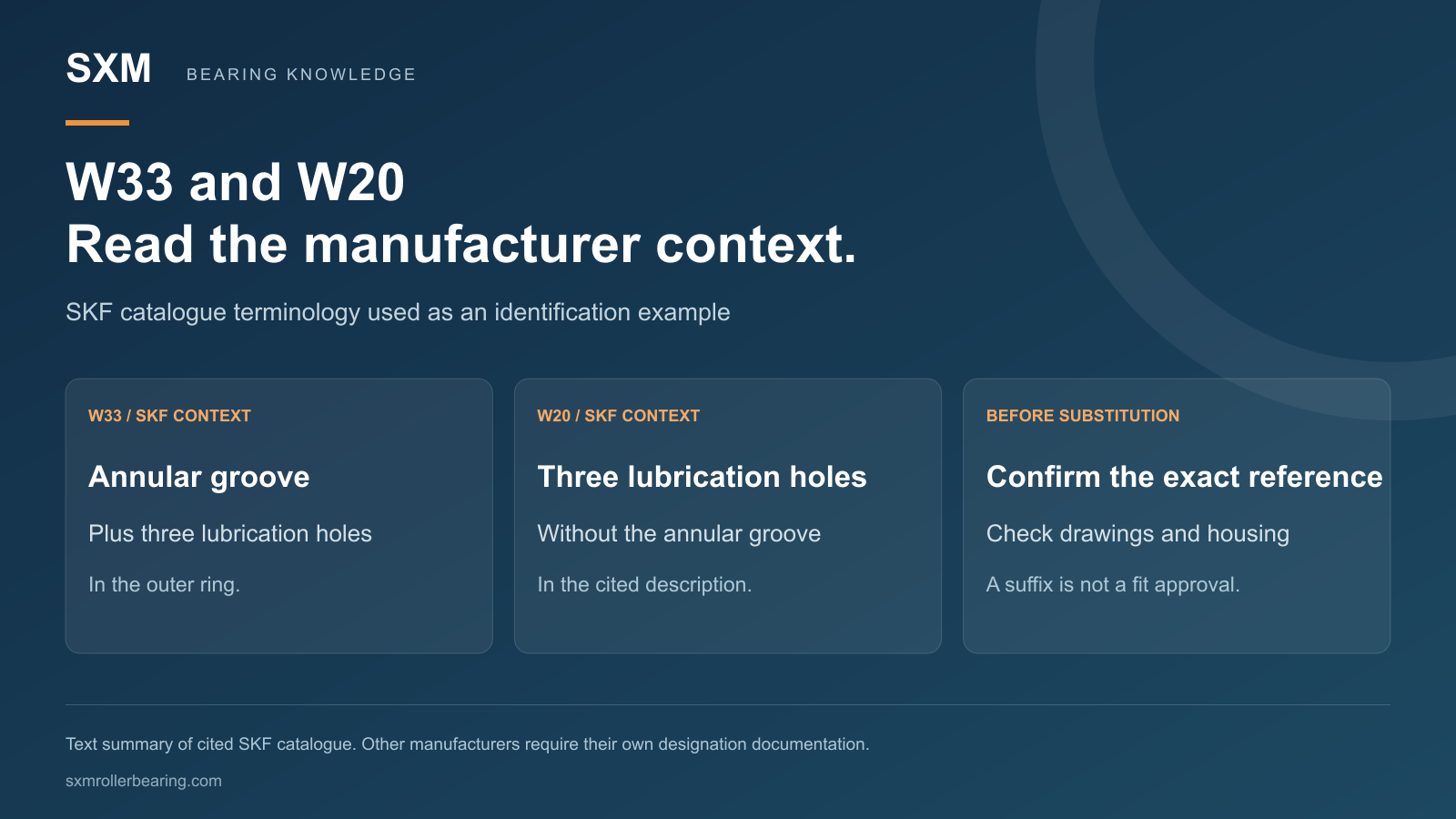
Check the housing feed path with the bearing feature
Begin with the assembly drawing
A close-up of the bearing alone does not show the complete lubrication arrangement. Ask maintenance for the housing drawing or parts reference and identify where lubricant enters the assembly. Record whether the available drawing represents the current equipment or an earlier revision.
Place the bearing reference and housing reference in the same enquiry. If the drawing contains a passage, groove or port that matters to the review, mark its location on a copy while keeping an unaltered original. Label annotations as observations or questions rather than approved changes.
Where drawings are unavailable, say so. A useful first enquiry can still include photographs and a list of missing information. It should not present a partially observed arrangement as a fully defined one.
Record modifications instead of assuming the original design remains intact
Maintenance history can matter. Ask whether the housing, grease connection, seals or supply lines have been changed. Include the relevant modification record if it exists, and distinguish a documented change from a technician’s recollection.
For example, a replacement review might begin with an old parts-list number and a recently changed housing. That is an illustrative procurement situation, not an SXM customer case. The practical response is to identify both versions and ask the responsible reviewer which arrangement the new bearing must satisfy.
Do not request that a supplier drill an additional hole or machine a groove from a photograph. Any proposed component or housing modification needs its own approved engineering scope, drawing and acceptance requirements.
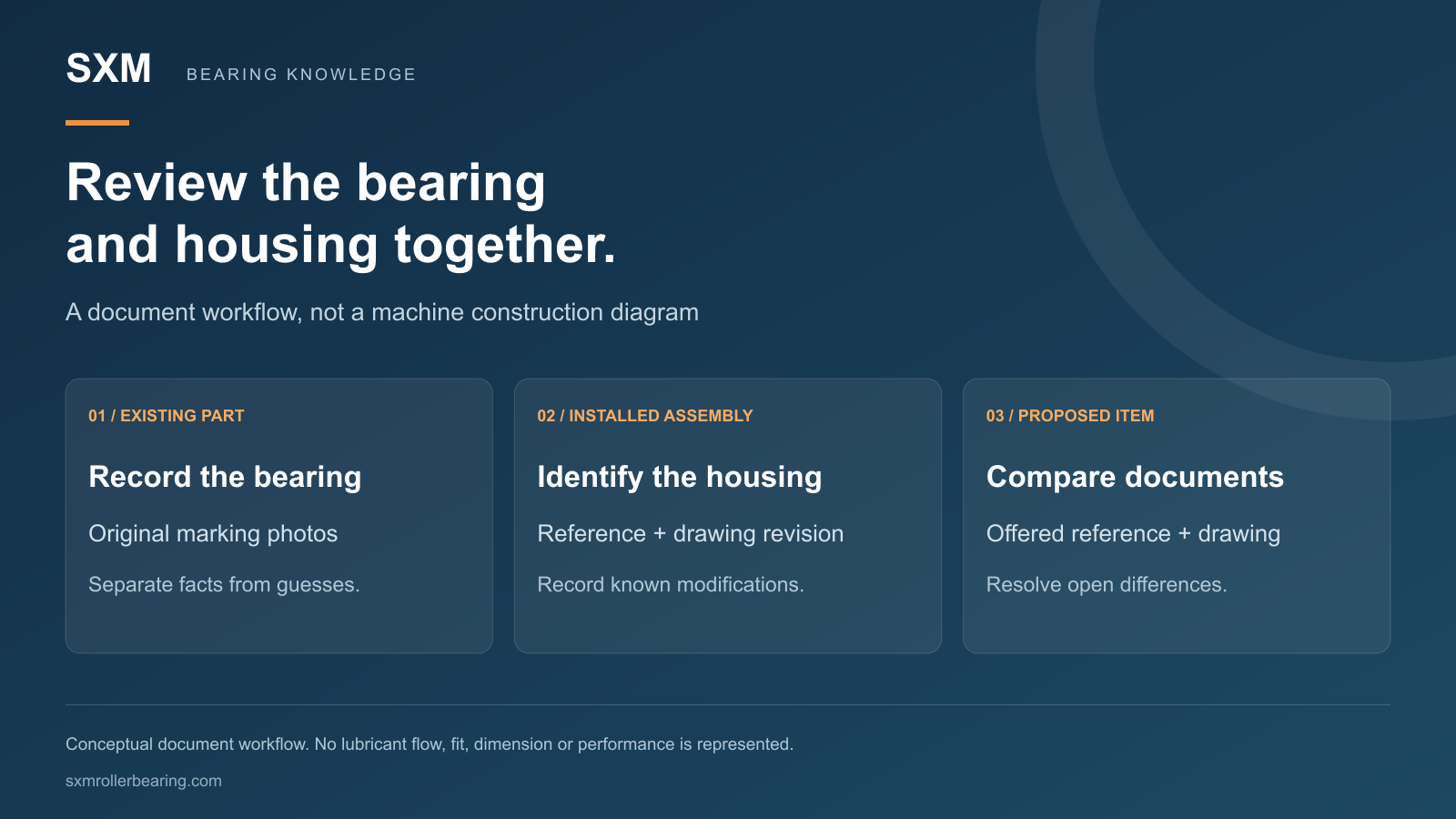
Photograph the information a supplier actually needs
Build a small, labelled photo set
Provide an overview of the removed bearing, a readable marking close-up, an outer-ring view and a housing overview. Where accessible and safe, add a view of the feed connection or relevant drawing detail. Give each image a simple identity, such as bearing A, machine position B or housing drawing revision C.
Keep the complete ring visible in at least one photograph. Include another angle when glare hides the lettering or a hole. A photograph can show that a feature appears to be present; it cannot establish an unmeasured dimension, internal passage condition or manufacturing tolerance.
Preserve the original images. Send annotations as separate copies so the technical reviewer can distinguish an actual marking from an added label. Do not retouch unclear characters into a plausible bearing number.
Record dimensions as measurements, not guesses
If requested, provide the measured bearing envelope and relevant groove or hole location information using the agreed drawing conventions. State who measured the part and whether the value came from the removed bearing, a catalogue or an equipment drawing.
Avoid converting a rough ruler photograph into a precision requirement. If a feature is inaccessible or the measuring method is uncertain, mark the value as unconfirmed. Ask which dimensions are needed to resolve the enquiry before arranging additional inspection.
Have a marking but no complete drawing? Send SXM your bearing reference, outer-ring photos and housing information to start a replacement enquiry. Identify the lubrication feature as a point for confirmation and include your quantity and equipment position.
Compare different manufacturers without creating a false equivalence
A similar feature description is not a cross-reference approval
NSK’s spherical roller bearing overview describes E4 as identifying an outer-ring oil groove and holes. This is an NSK designation explanation, not proof that an E4 reference and a W33 reference are interchangeable. NSK spherical roller bearings.
For a proposed alternative, compare the full references, drawings and equipment requirement. Keep the original manufacturer and proposed manufacturer in separate fields. Ask the supplier to explain each difference instead of replacing one suffix with another in the purchase description.
The final technical decision may involve requirements outside this article’s scope. Keep the lubrication-feature comparison attached to the wider replacement review so it cannot be mistaken for approval of the entire bearing.
Request an explicit exceptions list
A useful quotation identifies the exact offered reference and states what remains unconfirmed. Ask for a short list of differences from the original request, together with the drawing or document that supports each proposed feature.
Examples of unresolved items include an unreadable marking, an unidentified housing revision or a missing requirement for the feed arrangement. These should remain visible through purchasing. A low price does not resolve them, and a product photograph does not replace an agreed specification.
If the supplier offers more than one option, give each option its own reference and document set. Do not let the drawing for one option accompany the price for another without clarification.
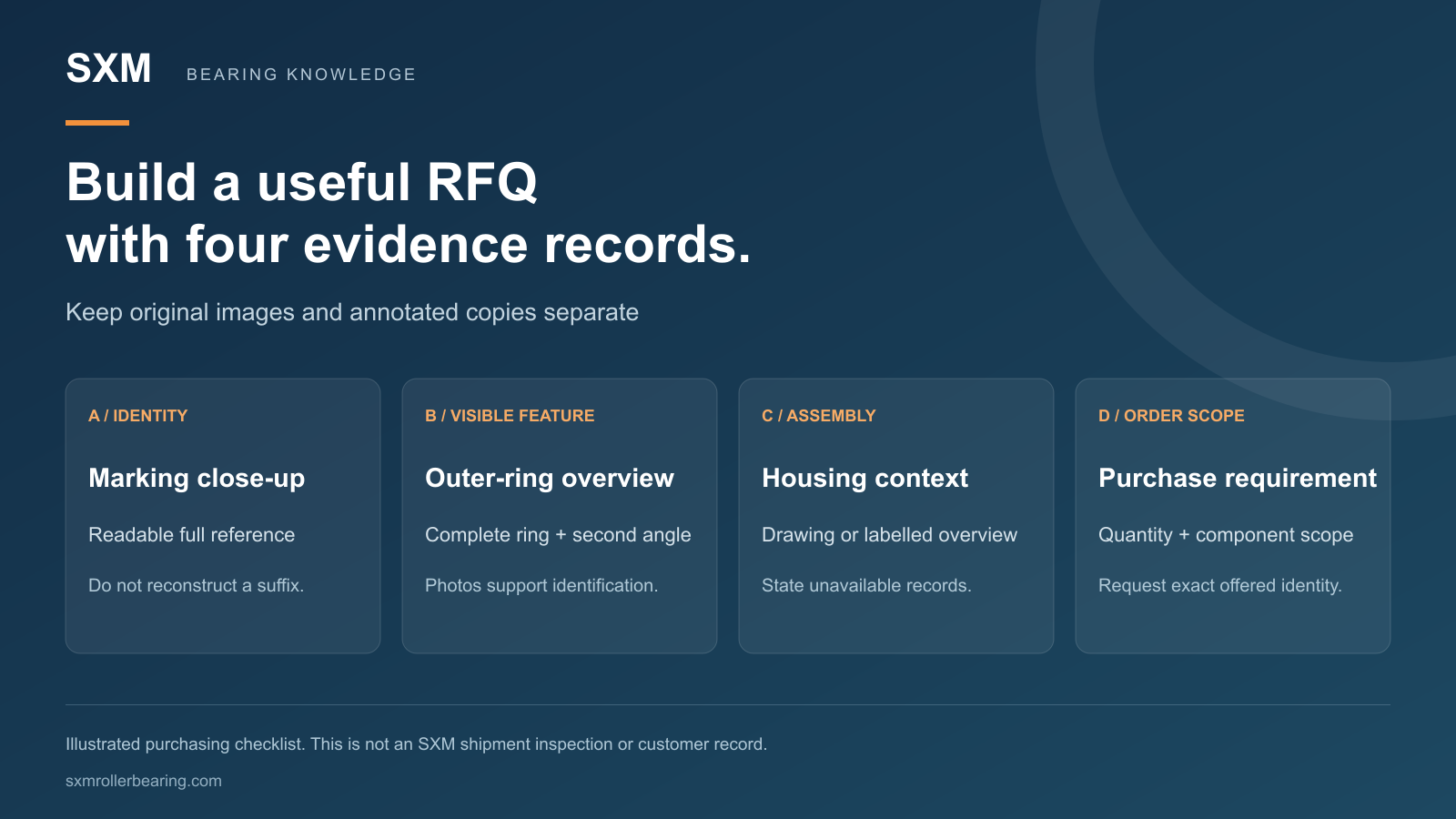
Prepare an RFQ that keeps technical questions attached to the order
The following checklist is a proposed purchasing workflow. It does not describe a completed SXM inspection or promise a particular quotation result.
| RFQ field | What to provide | How to handle uncertainty |
|---|---|---|
| Existing bearing | Manufacturer and complete reference, copied as marked. | Attach the original photo and flag unclear characters. |
| Requested item | Bearing only, assembly or another clearly defined scope. | Ask the supplier to state what the quoted unit includes. |
| Lubrication feature | Observed groove/holes and applicable drawing reference. | Separate observed features from required features. |
| Housing | Housing reference, drawing revision and feed connection context. | State when a drawing or modification record is missing. |
| Operating context | Equipment position and available maintenance information. | Use recorded information; label estimates. |
| Quantity | Number of bearings and number of machine positions. | Distinguish a trial request from a repeat-order plan. |
| Offered alternative | Exact proposed designation and supporting documents. | Require written clarification of differences. |
| Acceptance | Agreed identity, drawing revision and required evidence. | Resolve open items before order release. |
Include the purchasing contact and the person who can answer technical questions. This helps keep requests for clarification attached to the same enquiry rather than spreading them across unrelated email chains.
For repeat purchasing, retain the approved reference, drawing revision and original approval record. A previous order is useful history, but it should not silently override a later equipment change.
Copy-ready enquiry outline
We are reviewing a spherical roller bearing replacement for an industrial machine. Existing manufacturer/reference: [complete marking]. Quantity: [number]. Equipment position: [position]. We have attached the bearing marking, outer-ring views and [housing drawing/reference, if available]. Please identify the exact offered reference, confirm its lubrication groove/hole execution on the supplied documentation, and list any differences or information still required. Final replacement acceptance remains subject to our technical review.
This outline deliberately leaves unknown facts open. Replace bracketed fields with verified information instead of filling gaps with assumptions.
An illustrative review when the documents disagree
Consider an enquiry in which a maintenance photograph shows an outer-ring groove, while the purchasing spreadsheet lists only the basic bearing number. An older drawing is available, but nobody has yet confirmed whether it represents the installed housing. This is an editorial example, not a reported customer order or test.
Start by keeping the three records separate: the observed part, the purchasing description and the drawing. Ask maintenance to transcribe the complete readable marking. Ask the equipment owner to confirm the drawing revision or identify the missing record. Ask the supplier to describe the proposed product using its own exact designation and documentation.
The resulting decision log can be simple:
| Item | Present evidence | Open question | Required action |
|---|---|---|---|
| Removed bearing | Original photographs | Is every designation character readable? | Obtain another marking view if necessary. |
| Installed housing | Housing reference and overview | Does the available drawing represent this assembly? | Have the equipment owner confirm the revision. |
| Proposed replacement | Supplier reference and drawing | Which features differ from the request? | Obtain a written exceptions statement. |
| Purchasing description | Existing stock record | Does it capture the approved configuration? | Update the order description after technical approval. |
Keep the order pending while a required item remains unresolved. If the evidence supports an acceptable proposal, retain the approval with that exact reference and drawing revision. If it does not, request further information or another proposal. Neither path requires inventing a dimension or assuming that two suffixes have identical meaning.
This approach also gives purchasing a clearer basis for comparing quotations. Compare offers against the same documented requirement and acceptance scope, rather than treating all offers sharing a basic number as equivalent.
Agree on receiving checks before the shipment is released
Define evidence for the actual order
If the lubrication feature is important to the purchase, agree in advance how its identity will be checked. The requirement might call for photographs of the actual ordered items, marking records, a drawing reference or an agreed inspection record. Specify the item or lot to which each record relates.
A generic catalogue picture should not be labelled as a shipment inspection photograph. Similarly, an inspection scene on a website does not establish what was checked for your order. Ask for the evidence included in the commercial and technical agreement.
Avoid requesting an unspecified “quality certificate” as a substitute for describing the question. State whether you need identity confirmation, an agreed dimensional check or another defined record. The supplier can then explain the proposed evidence and any limitations.
Keep receiving and installation preparation connected
At receipt, compare the delivered identity and documents against the approved order before releasing the part for installation. Escalate a missing suffix, unexpected feature or conflicting drawing revision through the agreed review process.
Keep the old component and its identification records available until the replacement question is resolved. During installation preparation, use the equipment and bearing manufacturer’s applicable instructions. This article does not provide mounting settings, grease quantities or maintenance intervals.
If an unexpected operating condition later appears, record the observation and maintenance context. Do not diagnose a failure from a suffix alone or assume that a visible groove proves lubricant reached the intended location.
FAQ
Does W33 mean the bearing has extra clearance?
In the cited SKF description, W33 identifies lubrication features. Treat clearance as a separate designation and technical requirement. Preserve every field in the full reference and check the relevant documentation rather than assigning a clearance class from W33.
Can I replace W20 with W33?
Do not approve the substitution from the suffix comparison alone. Ask for the exact offered reference and a review of its documented features against the existing housing and assembly requirement. Any unresolved difference should remain explicit before purchasing.
Does a missing W33 suffix mean there are no lubrication holes?
No general conclusion follows from the missing letters alone. Some product designs include features without a separate suffix, as the cited catalogue illustrates. Check the exact manufacturer’s documentation and the actual proposed reference.
Is NSK E4 the same bearing specification as W33?
The cited descriptions concern lubrication features within different designation systems. They do not establish complete equivalence. A replacement decision still needs the full references, relevant drawings and the equipment requirement.
Can a photo confirm that the bearing is suitable?
A photo helps record markings and visible features. It cannot verify every dimension, internal detail or assembly condition. Use it to support a documented enquiry and identify the further information needed for technical acceptance.
What should I send if the old marking is unreadable?
Send unedited photographs from several angles, the equipment parts-list reference, any retained packaging identity and the housing or assembly drawing. Mark uncertain information clearly. Ask what additional measurements are required before selecting a replacement.
Conclusion: make the lubrication feature a documented purchase requirement
Use W33 as one part of a complete identification review. Keep the marking, outer-ring feature, housing feed arrangement and proposed replacement documents together. Obtain clarification of differences before approving an order, and carry the agreed identity into receiving and installation preparation.
Preparing a replacement purchase? Contact SXM with the full bearing designation, drawing or photos, housing reference and quantity. Ask for the exact proposed reference and the documents needed to review the lubrication feature before making your purchasing decision.